
Armenia: The Election Decided Less Than It Seems
In
Prime Minister Nikol Pashinyan has won Armenia’s 7 June parliamentary election, and not narrowly. His Civil Contract party has taken just under half the vote, more than double its nearest rival’s share and enough for a governing majority.
*******
Armenia: The Election Decided Less Than It Seems
Prime Minister Nikol Pashinyan has won Armenia’s 7 June parliamentary election, and not narrowly. His Civil Contract party has taken just under half the vote, more than double its nearest rival’s share and enough for a governing majority. Europe’s response was relief rather than jubilation: Pashinyan’s pro-peace, pro-European course has survived. Yet even a commanding win has not delivered the two-thirds majority needed to open the way to the signing of an already initialled peace agreement.
At the White House last August, with Trump mediating, Pashinyan and Azerbaijan’s President Aliyev witnessed their foreign ministers initial the text of an agreement to normalise relations between Armenia and Azerbaijan, twice at war over Nagorno-Karabakh. But Baku will not sign until Armenia amends its constitution. The sticking point is the constitution’s preambular reference to the 1990 Declaration of Independence. That declaration, in turn, invokes a 1989 joint decision on the reunification of Armenia and Nagorno-Karabakh, which Azerbaijan reads as a territorial claim.
Removing it requires two steps: a two-thirds parliamentary majority to call a referendum on a new constitution, then approval in the referendum by a majority of those who vote, provided the Yes votes amount to at least a quarter of all registered voters. Civil Contract has fallen short of the first bar by several seats, and the opposition holding the remaining seats has every incentive to keep it there. The agreement therefore remains unsigned.
The election was a test, not a settlement. Can the peace process survive when the government cannot muster the votes to call a referendum on a new constitution? Can Armenia manoeuvre among the outside powers competing for influence in the South Caucasus and deepen ties with the EU, rather than slide back into Russia’s orbit? And can it preserve democratic legitimacy while pursuing both? These are not separate questions: peace without popular backing remains fragile, diversification of relations without peace remains weak, and democracy without tangible results erodes from within. The direction Armenia takes will be decided over the years ahead, not by the vote count alone.
The obstacle is more than procedural because of what the referendum would ask Armenians to accept. Azerbaijan won the conflict. In 2023 it took Nagorno-Karabakh by force, and almost the entire Armenian population of the region – more than 100,000 people – was forced to flee to Armenia. The referendum would require Armenian society to adopt a new constitution without the reference Azerbaijan reads as a claim to territory that Armenia no longer controls. For many Armenians, to vote Yes would be to renounce a cause on which their country staked its identity for three decades. Pashinyan’s answer is Real Armenia, a doctrine that anchors national identity in today’s internationally recognised state rather than in territorial aspirations beyond its borders. A successful referendum would embed that intended refoundation in the constitution.
Many voters may refuse to accept that loss directly, and a No is a real possibility. The more hopeful reading is that Civil Contract’s strong result gives Baku reason to bank the progress made – a quieter border, an active demarcation commission and plans for stronger cross-regional connectivity – and defer the constitutional question. Turkey’s interest in eventually reopening its border with Armenia may reinforce that incentive. But that assumes Aliyev prefers patience to leverage, for which there is little evidence.
Armenia sits where outside powers compete for influence: the United States as mediator and investor; Turkey, unwilling to open its border without Baku’s go-ahead; Iran, wary of the agreed but unbuilt US-managed TRIPP transit route on its frontier; and Russia, bent on reclaiming lost control. Pashinyan’s strategy is to balance them while deepening ties with the EU.
Russia interfered in the election through economic and diplomatic pressure, restricting imports of Armenian goods and demanding that Yerevan choose between the Eurasian Economic Union and the EU, with Putin invoking Ukraine’s fate as a warning. Pashinyan declined the choice as premature. Information operations cast peace as capitulation and Pashinyan’s turn from Moscow as a danger. Armenian trust in Moscow has fallen sharply since the loss of Karabakh in 2023, which many Armenians blame on Russia’s failure as a security guarantor and peacekeeper. Yet a constitutional referendum would hand Russia a new target, and Moscow still has the means to exploit it.
A third issue underlies both the peace process and foreign-policy diversification: whether Armenia’s democracy is resilient enough for transformation. The campaign was bitterly polarised, each side framing the vote as survival or catastrophe. Pashinyan branded the three main opposition forces a “three-headed party of war”. The opposition cast his Real Armenia doctrine as a cover for surrendering sovereignty and land.
OSCE observers found the vote offered a genuine choice in a well-run process. But they also pointed to foreign pressure aimed at favouring the opposition, coordinated disinformation primarily from Russian actors, and legal proceedings that fuelled perceptions of selective enforcement, including against opposition leader Samvel Karapetyan. Pashinyan’s combative personal style – including derogatory language towards critics and displaced Karabakh Armenians – adds to the strain. Peace needs institutions and leadership, as well as public understanding and support. That is the test an election alone cannot settle.
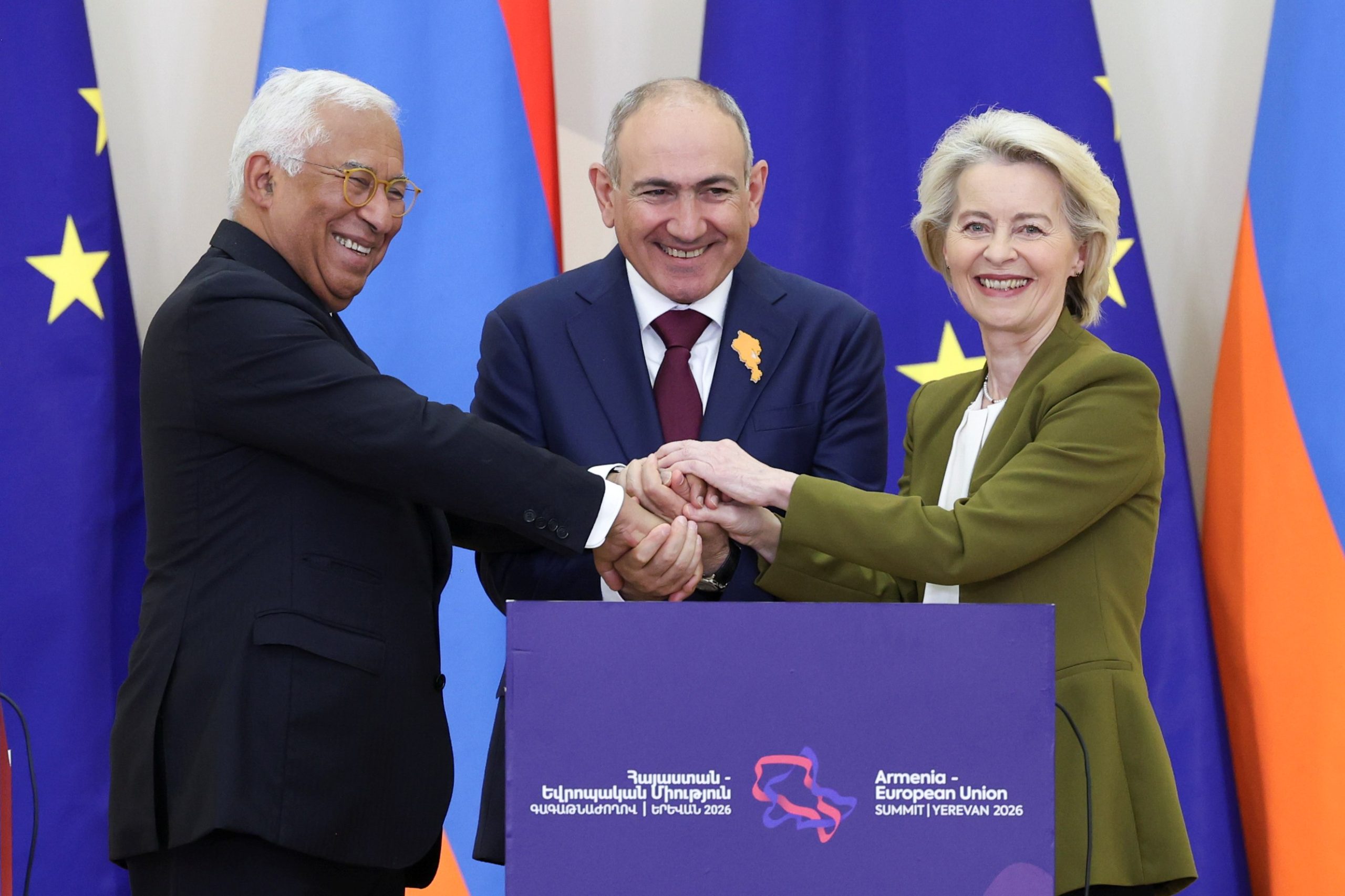
The lesson for Europe is one of limits and realism. In May, the first-ever EU-Armenia summit marked a deepening of relations, including an expected EUR 2.5 billion in Global Gateway investments, a Connectivity Partnership and a new EU Partnership Mission.
Yet the fine print was cooler than the rhetoric. The EU’s 2014 Association Agreement with Ukraine, concluded before candidacy and without a membership perspective, states that the Union “acknowledges the European aspirations of Ukraine and welcomes its European choice”. The EU-Armenia Summit Declaration uses only the first half of that formula: it “acknowledges the European aspirations of the Armenian people” but omits any welcome for a European choice. The reticence is striking because Armenia, unlike Ukraine in 2014, had already legislated for accession in a March 2025 law. The Declaration even presents that acknowledgement as a response to Armenia’s own legislative initiative, rather than as an EU offer of an accession path. What remains is partnership, not a membership perspective, whatever the warmth of von der Leyen’s “broader European family” language.
Europe’s support is easily misread. Azerbaijan won the conflict and holds the territory, while Aliyev has consolidated power and faces no comparable electoral constraint. Against that asymmetry, Pashinyan has tried, with courage, to turn defeat into a stable peace and a viable future for his country. To back this effort is not to take Armenia’s side against Azerbaijan, but to support the harder task of making the peace hold. That is why the EU courts Baku as deliberately as Yerevan, with connectivity the shared interest: the more Armenia, Azerbaijan and others are bound into a shared regional order, the firmer the ground beneath peace.
Armenians are not asking Europe to help them choose sides. Weeks before the vote, nearly six in ten favoured good relations with both the West and Russia. They are asking Europe to make its engagement tangible through investment, visa liberalisation and security rather than declarations. Europe cannot supply the seats Pashinyan lacks, rewrite the constitution or sign for Baku. Yet Armenia’s ability to maintain its balance depends heavily on Russia’s trajectory. The outcome of Russia’s war of aggression against Ukraine will weigh on the South Caucasus as it weighs on the whole of Europe’s eastern neighbourhood. For Europe, the task is not to celebrate Pashinyan’s victory, but to help Armenia withstand external pressure and internal division as it tries to turn defeat into peace, dependence into autonomy and polarisation into democratic resilience.
(Photo credit: © European Union, 2026)