
From Asia-Pacific to Indo-Pacific and Back: Strategic Possibilities for the EU and India
In
Mounting evidence suggests that the present US administration has decided to abandon the American Indo-Pacific Strategy of the last decade. Instead, Washington seeks to come to terms with China in a strictly bilateral context.
*******
From Asia-Pacific to Indo-Pacific and Back: Strategic Possibilities for the EU and India
Introduction
Mounting evidence suggests that the present US administration has decided to abandon the American Indo-Pacific Strategy of the last decade. Instead, Washington seeks to come to terms with China in a strictly bilateral context.
This shift has profound geopolitical consequences for America’s Asian partners, including the other three QUAD-members, Australia, India and Japan. It also goes against the EU’s Indo Pacific strategy, and it might impact NATO’s outreach to certain Asian nations.
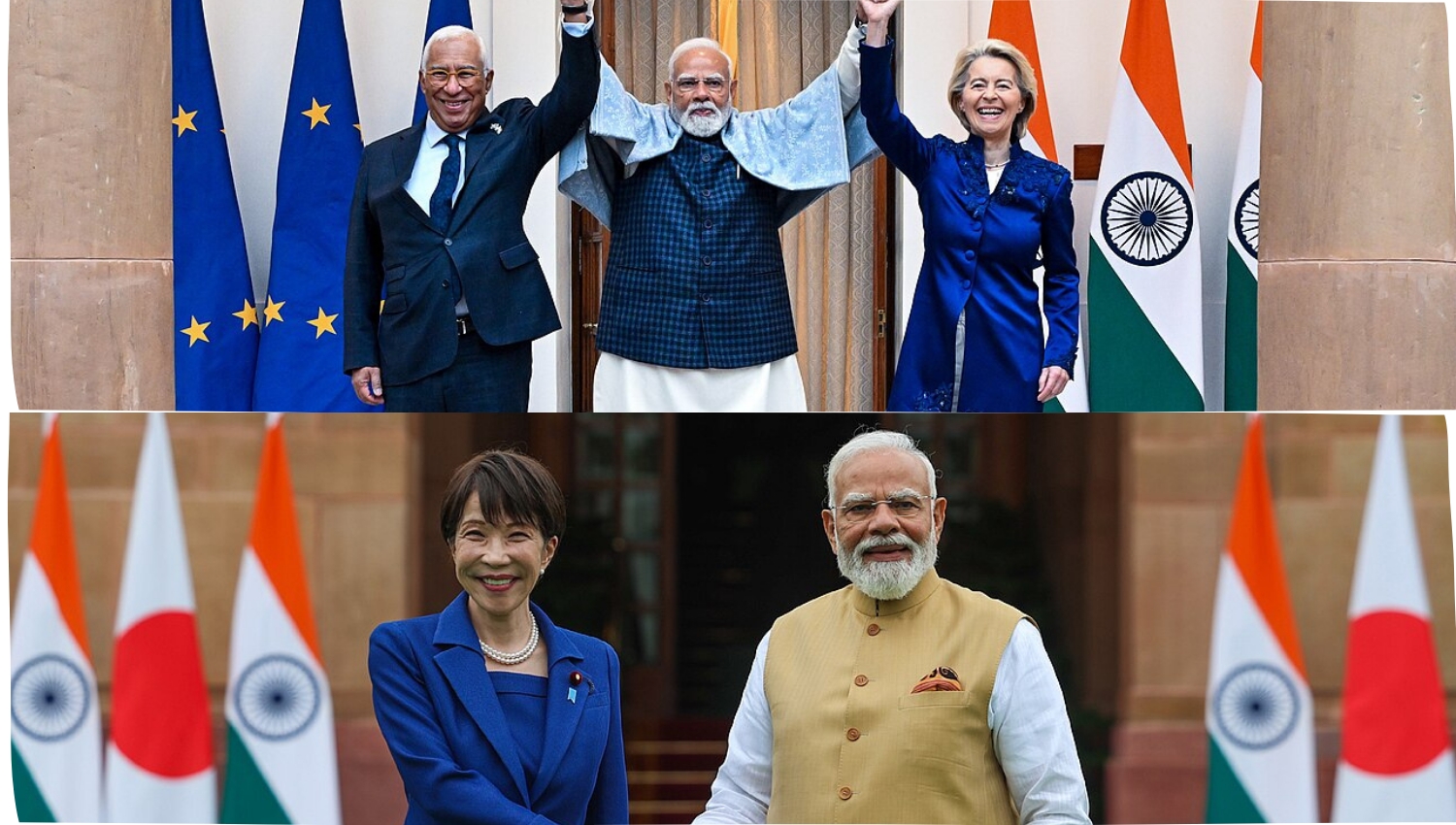
In response to these developments the EU and India should strengthen the Indo-Pacific dimension of their renewed strategic partnership.
1 The Evolution of the Indo-Pacific Construct
The geopolitical concept of an Indo-Pacific Strategy was first launched by the late Japanese Prime Minister Shinzo Abe in his speech to the Indian Parliament in 2007. During the first Trump-administration the term ‘Asia-Pacific’ was changed to ‘Indo-Pacific’ (cfr US National Security Strategy 2017). This was meant to underline the importance of India and the Indian Ocean to the US global strategy. One year later the United States Pacific Command (USPACOM) was renamed the United States Indo-Pacific Command (USINDOPACOM). The Quadrilateral Security Dialogue, or “Quad”—an informal grouping between Australia, Japan, India, and the United States—b became a high-profile forum that gave strong visibility to the Strategy.
After initial hesitations, New Delhi eventually embraced the Indo-Pacific concept. Prime Minister Modi put forward the Indian vision at the Shangri-La Dialogue in 2018. As noted by Bhonsale and Bansal, securing its interests in the Indian Ocean was paramount for India, and it needed to define its own approach to the Indo-Pacific. While India’s stance evolved, its relationship with the US played a key role in shaping this approach and leading to increased cooperation in defence and security.[1]
The EU for its part decided in 2020 —somewhat belatedly—that it needed its own Indo-Pacific document. A Joint Communication to the European Parliament and the Council, titled ‘The EU strategy for cooperation in the Indo-Pacific’ was published in June 2021. Furthermore, the Union started organizing a yearly EU-Indo-Pacific Ministerial Forum – up to date four have taken place. An Indo-Pacific Envoy was nominated.
2 The US Strategic Pivot: A Return to Bilateralism
Last summer the US started shifting away from its policy of China-containment. Driven exclusively by American interests, the main US-focus now is reaching a bilateral agreement with China.
As a result of this change in US-policy vis-à-vis China – India is no longer seen by Washington as an essential partner in Asia.
The clearest sign of this shift is the de-facto demotion of the QUAD partnership. The 2025 QUAD summit under Indian chairmanship never took place because of a lack of interest from President Trump. The Indo-Pacific strategy concept is no longer alive in Washington. It was not even mentioned in the US National Security document of November 2025. This development was symbolically confirmed in June of this year when the Pentagon announced that INDOPACOM (the US Indo-Pacific Command) would revert to its older name of PACOM.
In his speech at the Shangri-La Dialogue (26/05/26), US Secretary of War Hegseth set out the new approach the US is taking with regard to this region. Instead of ‘relying on broad, values-based coalitions the U.S. is prioritizing specific frontline allies—such as South Korea, the Philippines, and Japan—for critical defence and deterrence integration.’ Furthermore, regional partners were urged to ‘take greater self-defence responsibilities to preserve regional stability’ and move away from reliance on the US. In other words: no more broad coalition to contain China, and no word on India’s role.
3 Strategic Fallout: the downgrading of India and of Nato’s IP-outreach
The disappearance of the Indo-Pacific Strategy from American foreign and defence-policies is having an impact on the bilateral relationship between the US and India. What started last summer as a trade-related disagreement, has now clearly turned into a significant US change of policy vis-à-vis India. The signs last year were clear: the imposition of heavy tariffs on India imports, in part related to Indian purchases of Russian oil, accompanied by unfriendly American rhetoric and warming ties between Washington and Islamabad.
As a consequence, India has lost some of its geopolitical weight. Over the last 20 years India benefited from the American view that it served as an essential geopolitical counterweight in Asia against China. This is no longer the case. New Delhi is no longer a central partner for Washington in Asia, the US even seems to be ‘side-stepping’ India in South Asia itself (cfr Suhasini, Haider, The Hindu, 25/06).[2] A case in point is the appointment of Ambassador Sergio Gor to India. The latter combines his mission as American envoy to New Delhi with that of United States special envoy for South and Central Asian affairs. Ambassador Gor seems to receive more visibility for his role in Central Asia than for being the US ambassador to India. As reported in the New York Times on June 13th in an article on Gor, ‘Shishir Priyadarshi, the president of a think tank called the Chintan Research Foundation, said that wooing the Indian public did not appear to be part of Mr. Gor’s mandate.’[3]
The American change of policy could furthermore affect the way NATO will now approach the Indo-Pacific. It has been stated many times that the security of the Euro-Atlantic and that of the Indo-Pacific are interrelated. The IP4-grouping, – Japan, Australia, South Korea and New Zealand – was a more concrete outcome of this thinking within the NATO-context: how will it survive?
While NATO cannot act significantly without US support -even if some kind of European pillar were to come about within the organization- the EU has the potential to become more significant in the Indo-Pacific context. It has signed Security and Defence Partnerships with several of its partners in that region.
4 Seizing the opportunity: Forging a robust EU-India partnership in the Indo Pacific
The unilateral policy-decisions of the present US administration have led to a weakening of the Transatlantic alliance and to a splitting of the Western world. Rather than passively accepting these developments Europe, and more specifically the EU, should fill the geopolitical void thus created and start acting to protect its global interests.
At a time when the EU and India are coming closer, the US is downgrading Delhi’s status as a global partner. Contrary to the US, the EU has no reason to change its strategy in the Indo-Pacific: rationale defined in 2021 for this strategy remains valid. What the Union should change however, is the way it is implementing its stated objectives. It has is to overcome declaratory language and become a real Indo-Pacific actor.
As Raja Mohan rightly observes in the Indian Express (30/06/26), ‘The Indo-Pacific, …, is a structural reality of Asian politics, not a shifting American narrative.’ His advice is that ‘India should focus on building its own capabilities and deepening partnerships with like-minded Indo-Pacific countries to strengthen the regional balance of power’.[4]
The Indo-Pacific is however a region that holds great significance for Europe too. As stated in the preface to the Security and Defence Partnership (SDP) between India and the EU (January 2026) ‘Europe and the Indo-Pacific are deeply interconnected and interdependent in geo-political, economic, and security terms.’ The EU too, wants Asia’s balance of power to be strengthened. The latter will not happen on the basis of bilateral arrangements between the US and China. But it will become stronger through a credible partnership between the EU and India.
Now that the Security and Defence Partnership has been formally signed between the Union and India (January 27th, 2026) its mechanisms should be used – see point 6.d of the SDP:’ The EU and India have also recently established a dedicated dialogue on the Indo-Pacific’.
This dialogue should actually be expanded and become the basis for a broader Indo-Pacific partnership. The EU and India, together with significant like-minded Indo Pacific partners such as Japan, Australia, South Korea and New Zealand, should take the initiative to restart an Indo-Pacific partnership based on the original principles behind this concept.
The recent visit of Japanese Prime Minister Takaichi to India (July 1-2), during which both countries agreed i.a. to deepen their strategic relationship and to expand maritime security cooperation, indicates that Tokyo, just as the EU, intends to strengthen its Free and Open Indo-Pacific Policy[5] by extending cooperation with New Delhi. Based upon their common ambitions for the Indo-Pacific, Brussels, Tokyo and New Delhi should establish a trilateral forum to work together in fields such as economic and maritime security.
While the US may have decided that it does not need to work with other countries on an equal footing, the EU and India, as well as many of their partners in the Indo-Pacific region, still believe in a rules-based international order. They should act accordingly.
References
[1] ‘India’s Indo-Pacific Strategy Strengthening Partnerships and Navigating Challenges’. Mihir Shekhar Bhonsale and Dhruv Bansal, Indo-Pacific Civil society forum, BRIEFING PAPER #5/October 2024.
[2] ‘PACON, the deeper meaning behind a dropped prefix’. Suhasini Haider, The Hindu, 25/06/26.
[3] ‘How Sergio Gor Is Transforming the Role of U.S. Ambassador in the Trump Era’, Anton Troianovski, NYT, 13/06/26
[4] ‘The Indo-Pacific is here to stay — with or without Washington’, Raja Mohan, Indian Express, 01/07/26
[5] ‘Japan’s FOIP turns to India for regional resilience’. Yasuyuki Ishida, East Asia Forum, 03/07/26
(Photo credit: Wikimedia Commons)