
This Means War! Operationalising Art. 42.7 TEU
In
- EU and strategic partners,
- EU strategy and foreign policy,
- Europe in the World,
- European defence / NATO,
Activating Article 42.7 of the Treaty means that, we, all twenty-seven EU Member States, are at war. As talk of operationalising 42.7 has become fashionable, this must be absolutely clear.
*******
This Means War!
Operationalising Art. 42.7 TEU
Activating Article 42.7 of the Treaty means that, we, all twenty-seven EU Member States, are at war. As talk of operationalising 42.7 has become fashionable, this must be absolutely clear. This is not about sending a handful of cyber experts; this is about war. And aggression by a peer competitor requires hard-hitting retaliation, a continental war economy, and a combined EU-NATO Grand Strategy directed by a true War Cabinet. 42.7 should not be activated for anything less, or it loses its moral significance and deterrent value.
The first phrase of Art. 42.7 is very powerful: “If a Member State is the victim of armed aggression on its territory, the other Member States shall have towards it an obligation of aid and assistance by all the means in their power”. This is an expression of the deep bond between the members of the Union. Their vital interests are inextricably linked together, hence there is no limit on their solidarity, and they will have recourse to the ultimate instrument to help each other – war.
That language traces its origin to the 1947 Treaty of Dunkirk between Britain and France, the first post-war alliance in Europe. In 1948 the same language was used in Article V of the Brussels Treaty, creating the Western Union between Britain, France, and the Benelux countries. That in turn became the Western European Union when West-Germany and Italy signed the Modified Brussels Treaty in 1954. Political and military leaders knew very well why they signed: to deter or to win a war against the Soviet Union.
In practice, planning for collective territorial defence soon shifted to NATO. Nevertheless, the signatories attached great importance to Article V, witness the fact that even though the WEU had long become dormant, the organisation was only formally dissolved once they were certain that this collective defence commitment was preserved by including it in the Lisbon Treaty. In 2009, the EU itself thus became an alliance.
Today, however, many seem to see the activation of Art. 42.7 as a procedural step, that mainly unlocks additional procedural options, and perhaps some very specific measures of support (such as the Hybrid Response Teams). But the power of our bureaucracy will not deter any aggressor. With this attitude, 42.7 becomes useless, and the notion of solidarity loses all meaning. Such callous attitude towards a core article of our Union is irresponsible.
WAR
Art. 42.7 has been activated once, at the request of France, following the terrorist attacks in Paris of 13 November 2015. For the first time since then, in early May 2026, the EU very usefully organised a wargame to test 42.7 against another scenario: a lethal hybrid attack on a Member State by a foreign power. What can we learn from this?
The first conclusion is simple but fundamental: this is about war. Just like NATO’s Art. 5, Art. 42.7 should not be activated for anything less, or it loses its moral significance and its deterrent value. If the issue can be solved by deploying a dozen experts on hybrid threats, it is obviously not a war, and neither article should be invoked. Other instruments can be used, such as the “solidarity clause”: Art. 222 TfEU.
War can be either a classic armed aggression, or a hybrid attack that is so lethal or disruptive that we consider it an act of war. NATO has explicitly broadened the interpretation of Art. 5 in this sense to strengthen deterrence; following the wargame, the EU should do the same.
There clearly is an element of judgement here: not every hybrid attack is an act of war. This is why the current activation procedure for 42.7 is deficient; dangerous even. In 2015, the Council announced that activation does not require an explicit Council decision: by invoking 42.7, France ipso facto activated it. But what if Member States disagree about the severity or the origin of a hybrid attack? While any action taken by the Member State under attack will have implications for all. Just like in NATO or earlier in the WEU, one cannot leave the ascertainment of the state of war and the choice of actions to be taken to a single Member State; this must be an explicit collective decision.
Defence
Since 42.7 is about war, and war only, there is no scenario in which it would be activated and NATO’s Art. 5 would not. The EU’s wargame rightfully did not include territorial defence, therefore: that is what the defence plans and the command structure at NATO are for.
Unless, obviously, the EU Member State under attack is not a NATO ally. Cyprus is mostly at risk here, as the ongoing crisis in the Middle East and the Gulf proves: drones had to be intercepted in its airspace. Turkey apparently made very clear its total opposition to any NATO involvement in the defence of Cyprus. Until the exclusion of Cyprus from NATO is undone, the EU must therefore plan and wargame for the collective territorial defence of Cyprus against all possible threats, and pre-arrange command & control.
Ukraine must be on the agenda as well, because it is a candidate for EU membership. The moment it joins the Union, in whichever form, 42.7 must apply. Furthermore, the Coalition of the Willing, of European states, is considering to guarantee the security of Ukraine once there is a ceasefire, even before its accession to the EU. The Coalition itself can conduct any pre-deployment of forces in Ukraine as part of that guarantee, using French and British headquarters. But if Russia calls our bluff and invades Ukraine a third time, then only the NATO command structure can run what will be a Russian-European war, for which both Art. 5 and 42.7 will have to be activated, even if the US is not part of the Coalition.
NATO must also adapt its defence plans and wargames, therefore. They must include a Ukraine scenario, and, in fact, a scenario in which the US, at least in the initial stages of the war, leaves it to the Europeans to fight the conventional battle, with at most limited support in terms of American strategic enablers. For that is what the second Trump administration has been telling Europe to prepare for.
Retaliation & Economics
If military defence is organized through NATO, there is a lot more to war than military operations. There are whole dimensions of Art. 42.7 that have yet to be explored.
For one, current EU thinking is largely focused on assisting the Member State under attack, notably in case of a hybrid attack. The EU wargame established that the EU must act as a clearing house to coordinate such measures. Contrary, in fact, to the activation in 2015, when it was left to France to address bilateral requests to individual Member States. The primary responsibility for building resilience against hybrid attacks lies, of course, with national authorities. But in any war, retaliation against the aggressor will also be called for. That demands collective action, to show the aggressor that he has crossed the red line and is now at war with Europe. Retaliation can take many shapes: overt actions such as economic sanctions or a blockade, but covert operations as well – hybrid attacks of our own. Competence for the former mostly lies with the EU; for the latter, with the nations rather than, for now, with NATO. What is the chain of command for retaliation?
Moreover, in a war against a peer competitor, one has to organise a war economy. Communications, transport, energy & raw materials, weapons production, budgets & currencies: we actually have no idea who will take charge if we are at war. Many of the relevant competences definitely are with the EU, including the Eurogroup and the European Central Bank. That is why activating 42.7 must be understood as ascertaining a state of war. It constitutes the legal basis, therefore, to activate emergency powers and an economic war plan – which many Member States have or are developing, but are inexistent at the EU level.
Conclusion: Grand Strategy
What we really need is a combined EU-NATO wargame at the level of Grand Strategy. The assumption that once Art. 5 is activated, NATO plans will tell us everything that needs to be done, is completely wrong. Yes, SACEUR will assume command of our forces, and the relevant Regional Defence Plan will guide initial operations. These are military decisions; but many political-strategic and military-strategic decisions will also have to be taken. Do we limit ourselves to defending the ally that is under attack, or do we start operations against the aggressor in other theatres? To which states beyond the EU and NATO do we reach out, with which requests or demands, and with which offers or threats? And, as stated above, how to organise a war economy? These are not decisions for SACEUR or even the North Atlantic Council or the Political and Security Committee, but for Heads of State and Government.
One conclusion of such a wargame can be foretold: our current institutional set-up is not fit for purpose. We need a War Cabinet: a small executive body of a limited number of Heads of State and Government, the Presidents of the European Council and Commission, and the NATO Secretary-General, who are empowered by the broader EU and NATO membership to set strategy and give orders to NATO, the EU, and our national armed forces, security services, bureaucracies, and private companies.
That we plan for our collective territorial defence through NATO should not detract from the moral power and deterrent value of Art. 42.7 TEU. It must be understood as the absolute commitment to defend each other, against all enemies, in every scenario, with everything in our power. Do not take this lightly.
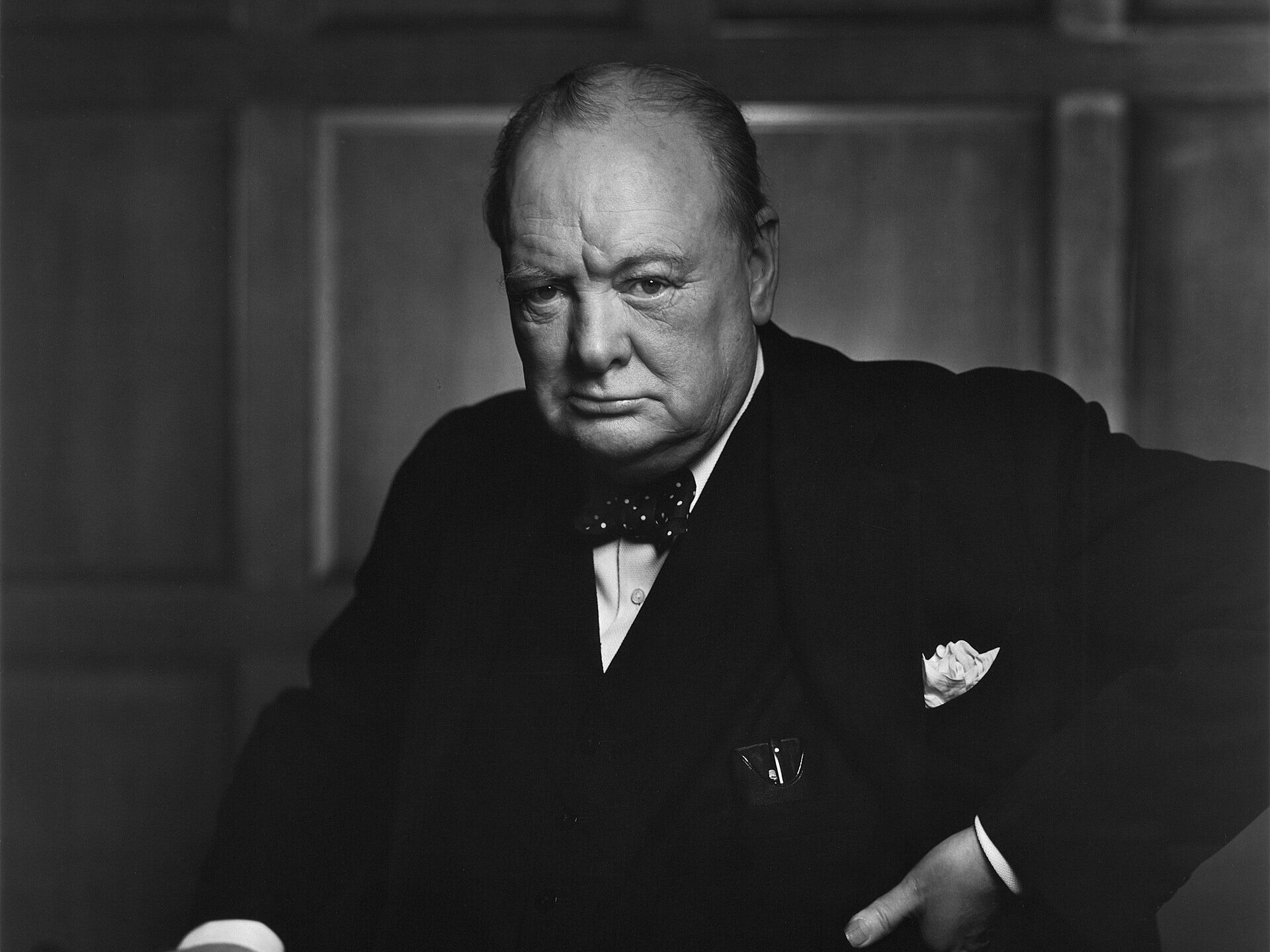
Prof. Dr Sven Biscop is the acting Director-General of Egmont and lectures at Ghent University. Having read the memoirs and diaries of Churchill, Ismay, Alanbrooke, Colville, and others, he perhaps romanticises Churchill’s war cabinet too much – but then Britain did win the war.
This article was subsequently published in Spanish in Revista Ejercitos.
(Photo credit: Wikimedia Commons)