
The Tervuren Museum Mining Archives: Mystery Unveiled
In
On 17 July 2025, a cooperation agreement on mining projects (rather than an MoU) was concluded between the DRC Ministry of Mines and the private society KoBold Metals, including an unusual article 5
*******
[version française ci-dessous]
The Tervuren Museum Mining Archives:
Mystery Unveiled
On 17 July 2025, a cooperation agreement on mining projects (rather than an MoU) was concluded between the DRC Ministry of Mines and the private society KoBold Metals, including an unusual article 5 stipulating “In order to accelerate free access to geoscientific data, KoBold Metals will deploy a team to the RDC geological archives kept at the Royal Museum of Central Africa to start digitalization of these documents before 31 July 2025”.
The Royal Museum for Central Africa (RMCA), a Belgian public federal scientific institution, was not informed at all, even less a party to this agreement. What is behind it? What is the content and importance of these archives? Why the pressure from KoBold? What is the position of the RMCA? In the following article, we try to summarize the main facts.
-
What are the archives?
Obviously, the RMCA is a product of colonial times, but since the nineties it has progressively undergone profound changes and its current permanent exhibition is even very critical of colonial domination. The RMCA includes a wide array of research departments in natural and human sciences, including a geology department that manages its archives and conducts contemporary geological research in African countries.
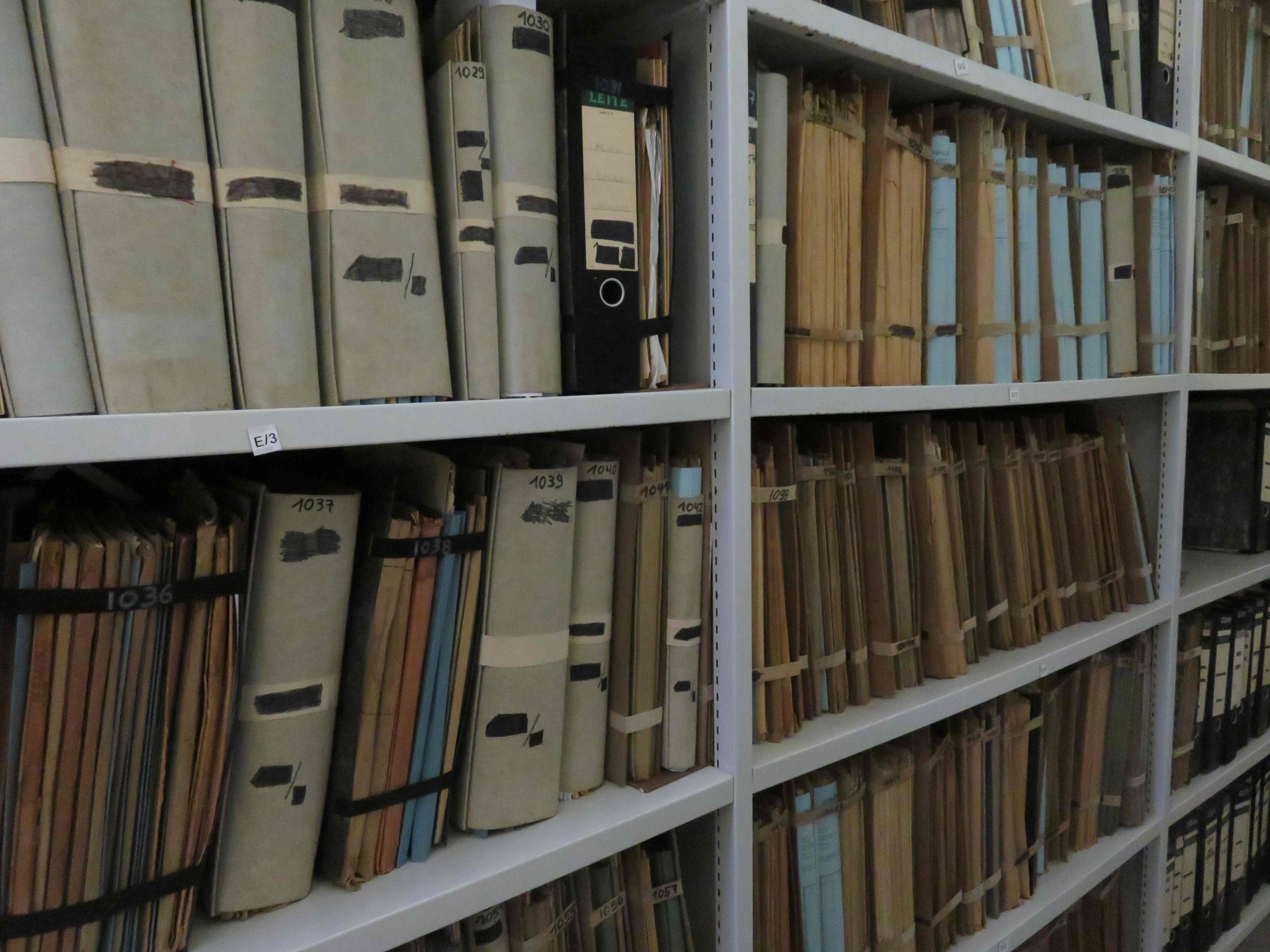
Sections of the RMCA archives were deposited by private mining companies that ceased activities in Congo around or after independence, including important funds from Forminière, Géomines and the Compagnie Minière des Grands Lacs, and from organizations such as the Comité Spécial du Katanga. The archives also include research and exploration data from individual geologists and from multidisciplinary exploration campaigns in the DRC, as well as geological data obtained through research undertaken by RMCA geologists. A large volume of relevant archives is held by the Belgian State Archives, including the archive collection from the “Union Minière du Haut Katanga.” The total volume for both is estimated to be up to 7 million pages.
The colonial and mining company archives, about four fifths of the total volume, ended up in the RMCA mainly through close personal contacts between geologists in the colony and those working in Tervuren. In most cases the transfer is not even documented.
The archives ‘considerable scientific importance became overshadowed by its potential economic value as some files contain detailed mineral exploration reports and other information about mineral deposit occurrences, which provide important indicators for mining companies to undertake further exploration of the DRC subsoil.
Access to the archives was always free for academic research. Access for companies, subject to a fee, was discontinued in 2021 awaiting an agreement with the DRC government about its future modalities.
-
What is KoBold Metals?
The company was created in 2018, led by scientists, and funded by several types of investing companies, including T. Rowe Price (Investment management), Breakthrough Energy Ventures (Bill Gates, Jeff Bezos), Andreessen Horowitz (venture capital group). It has no identifiable beneficial owner and is not quoted on the stock exchange.
The company wants to update and renew mining exploration techniques by intensive use of AI. It is active in Zambia where they develop the Mingomba copper mine project, aiming to become the largest copper producer in Zambia with an output expected to be over 300 000 tons per year. In the DRC, KoBold tries to develop a section of a huge lithium deposit in Manono, North Katanga, but it is still entangled in a legal dispute with the Australian company AVZ mining. This does not deter the company from announcing a huge exploration campaign in its Manono concessions.
KoBold Metals obviously wants to benefit from the Trump administration’s CRM policy and its strategic partnership agreement with the DR Congo. It could be awarded preferential treatment provided by the agreement to US based companies.
As a company focused on high-tech exploration, it is naturally very much interested in the Tervuren archives which also include an important collection of documents concerning Manono. Their request to scan the entire archive collection to explore the digital files with AI to find potential mineral indicators, in principle throughout the DRC, was hitherto refused. KoBold is thought to have launched a large media campaign to put pressure on the RMCA and the Belgian government to release its archives to KoBold for digitalization, underlining their roots in colonial times and suggesting the Museum refuses transparency which would benefit the DRC government.
But is this really true?
-
The legal, scientific, and ethical problems
As a federal scientific institution, the RMCA is ruled by the European Union legislation on transparency of scientific data[1], and by the legal principle (by case law) that Belgian federal collections are inalienable and can therefore not be sold to private actors. The Belgian ministries for Foreign Affairs and of Scientific Research are clear about this as well as about its inherently public nature.
The exploration and commercial approach from KoBold Metals is also incompatible with the scientific and public service framework of the RMCA There are obviously no guarantees, even if written on paper, that a private company will restore data of potential economic interest to a public institution or to the public in general. Private or first access to these data obtained with a technologically advanced AI program would thus provide KoBold with an important competitive advantage towards other companies and could interfere with the mining sector governance by the DRC authorities.
KoBold reportedly contributed to the digitalization of Zambian mining archives in two years resulting in the creation of a public website. It is unclear however whether data with potential economic value for KoBold are included.
From an ethical point of view, it is hardly legitimate to transfer publicly available data to a private company. One could obviously also argue that it is not legitimate either to keep DRC geological data in a Belgian scientific institution: the RMCA nevertheless has undertaken several initiatives to increasingly grant access to its data.
-
Tervuren Transparency
The English press most often describes the RMCA as eternally burdened with the original colonial sin, overlooking the transformation of the Museum over time. As an example, the RMCA has digitized its collection of more than 31 000 geological, topographical, administrative, and thematic maps which can be accessed through an online catalogue. (https://geocatalogue.africamuseum.be/geonetwork/srv/eng/catalog.search#/searchtext).
From 2003-2012 a project funded by Belgian Development Cooperation was implemented, initially entitled “Constitution in the DRC and Belgium of a geological and mining database network on the DRC”. It involved a partnership between RMCA and five DRC institutions (Center for Geological and Mining Research CRGM, University of Lubumbashi, the Mining Technical Coordination and Planning Cell CTCPM, the Bakwanga Mining Company MIBA, the Gécamines and at a later stage the DRC Mining Registry). This resulted in the creation of a database with metadata about the archives of all partners (minus MIBA and Gécamines) accessible online on https://drcmining.africamuseum.be/en. It includes references (not the document itself) to archive documents, geological and mineralogical maps, aerial photographs, inventoried mining sites etc. By submitting geolocation data, one can localize a geographical area and find references to the available information about the area in the interlinked databases of the institutions where the data are stored.
The project was not entirely completed because the World Bank – funded Promines project took over the development of a national database which was unfortunately not completed either. The Promines database project was reportedly finalized for artisanal mining, and topographic base maps were elaborated for selected areas (Katanga and Equateur) only, allowing the identification of priority targets for exploration.
-
The current digitalization project
When KoBold Metals put pressure on the RMCA, the latter was already engaged in discussions with DRC authorities about sharing of geoscientific information, and funding subsequently became available through participation in the EU-funded PanAfGeo project (Pan-African Support to geological sciences and technology), coordinated by the BGRM (French geological survey).
During the first three years, all available archival data for specific parts of three selected areas will be digitalized and provided as input for research and exploration on the ground. The areas, as proposed by the DRC authorities,, are sections of the Manono area (for lithium, tin, tantalum), the Dibaya and Luiza areas (Kasai Central) (for nickel, chrome, diamonds) and several areas in Kongo Central (for graphite, copper-lead-zinc, aluminum).
Supplementary funding is foreseen for the next phase when archives concerning all other parts of the DRC will be digitalized and made available. An agreement will be concluded with the DRC government about the accessibility of the data.
Conclusion
During the Mobutu regime and the 1996-1997 and 1998-2002 wars, scientific cooperation between the RMCA and the DRC was almost impossible. Since its resumption in 2003, data sharing of maps and historical and more recent geological information has been steadily increasing, contrary to the widespread myth about Tervuren as a neo-colonial institution which wants to monopolize data essential for the economic advancement of the DRC, this is part of a profound reform process of the Museum over the last decades. Provided adequate funding, the currently ongoing digitalization project must end up in total transparency and data sharing, enabling the DRC government to negotiate from an equitable position with foreign investors and mining companies. This process obviously offers more solid guarantees for scientific integrity, transparency, and publicly monitored cooperation with the DRC government than similar initiatives with a private company.
[1] There is not one legal act but various EU rules and regulations including the Open Data directive (Directive (EU) 2019/1024 of the European Parliament and of the Council, adopted on 20 June 2019), the Data Governance act (Regulation (EU) 2022/868) and the overarching EU Open Science Policy.
Les archives minières du Musée de Tervuren : le mystère dévoilé
Le 17 juillet 2025, un accord de coopération portant sur des projets miniers (ou plutôt un protocole d’accord) a été conclu entre le ministère des Mines de la RDC et la société privée KoBold Metals, comprenant un article 5 inhabituel stipulant « Afin d’accélérer l’accès libre aux données géoscientifiques, KoBold Metals déploiera une équipe aux archives géologiques de la RDC conservées au Musée royal de l’Afrique Centrale pour commencer la numérisation des documents avant le 31 juillet 2025».
Le Musée Royal de l’Afrique Centrale (MRAC), une institution scientifique fédérale publique belge, n’a pas été informé du tout, et encore moins n’était-il partie à cet accord. Qu’est-ce qui se cache derrière tout cela ? Quel est le contenu et l’importance de ces archives ? Pourquoi cette pression de la part de KoBold ? Quelle est la position du MRCA ? Nous tentons ci-après de résumer les principaux faits.
-
Que sont ces archives ?
Il est évident que le MRCA est un héritage de l’époque coloniale, mais depuis les années 1990, il a progressivement subi de profonds changements et son exposition permanente actuelle se montre même très critique à l’égard de la domination coloniale. Le MRAC comprend un large éventail de départements de recherche en sciences naturelles et humaines, dont un département de géologie qui gère ses archives et mène des recherches géologiques contemporaines dans des pays africains.
Certaines archives du MRAC ont été déposées par des sociétés minières privées ayant cessé leurs activités au Congo aux alentours de l’indépendance ou après, notamment d’importants fonds provenant de la Forminière, de la Géomines et de la Compagnie Minière des Grands Lacs, ainsi que d’organisations telles que le Comité Spécial du Katanga. Les archives comprennent également des données de recherche et d’exploration provenant de géologues individuels et de campagnes d’exploration multidisciplinaires menées en RDC, ainsi que des données géologiques issues des recherches menées par les géologues du MRAC. Un volume important d’archives pertinentes est conservé aux Archives de l’État belge, notamment le fonds d’archives de l’« Union Minière du Haut-Katanga ». Le volume total de ces deux fonds est estimé à près de 7 millions de pages.
Les archives coloniales et celles des sociétés minières, qui représentent environ les quatre cinquièmes du volume total, ont abouti au MRAC principalement grâce à des contacts personnels étroits entre les géologues de la colonie et ceux travaillant à Tervuren. Dans la plupart des cas, ce transfert n’est même pas documenté.
L’importance scientifique considérable de ces archives a été éclipsée par leur valeur économique potentielle, car certains dossiers contiennent des rapports détaillés d’exploration minière et d’autres informations sur la présence de gisements minéraux, qui constituent des indicateurs importants permettant aux sociétés minières de poursuivre l’exploration du sous-sol de la RDC.
L’accès aux archives a toujours été gratuit pour la recherche universitaire. L’accès réservé aux entreprises, payant, a été suspendu en 2021 dans l’attente d’un accord avec le gouvernement de la RDC concernant ses futures modalités.
-
Qu’est-ce que KoBold Metals ?
La société a été créée en 2018, sous la direction de personnalités scientifiques, et financée par plusieurs types de sociétés d’investissement, dont T. Rowe Price (gestion d’actifs), Breakthrough Energy Ventures (Bill Gates, Jeff Bezos) et Andreessen Horowitz (groupe de capital-risque). Elle n’a pas de bénéficiaire effectif identifiable et n’est pas cotée en bourse.
La société souhaite moderniser et renouveler les techniques d’exploration minière grâce à une utilisation intensive de l’IA. Elle est active en Zambie, où elle développe le projet de mine de cuivre de Mingomba, avec pour objectif de devenir le plus grand producteur de cuivre du pays, avec une production prévue de plus de 300 000 tonnes par an. En RDC, KoBold tente d’exploiter une partie d’un immense gisement de lithium à Manono, dans le nord du Katanga, mais elle est toujours empêtrée dans un litige juridique avec la société australienne AVZ Mining. Cela n’empêche pas la société d’annoncer une vaste campagne d’exploration dans ses concessions de Manono.
KoBold Metals souhaite manifestement tirer parti de la politique CRM de l’administration Trump et de son accord de partenariat stratégique avec la RD Congo. Elle pourrait bénéficier du traitement préférentiel prévu par cet accord pour les entreprises basées aux États-Unis.
En tant qu’entreprise spécialisée dans l’exploration de haute technologie, elle s’intéresse naturellement de très près aux archives de Tervuren, qui comprennent également une importante collection de documents concernant Manono. Sa demande visant à numériser l’intégralité de la collection d’archives afin d’explorer les fichiers numérisés à l’aide de l’IA pour détecter des indicateurs minéraux potentiels, en principe sur l’ensemble du territoire de la RDC, a jusqu’à présent été refusée. KoBold aurait lancé une vaste campagne médiatique pour faire pression sur le RMCA et le gouvernement belge afin qu’ils lui remettent leurs archives en vue de leur numérisation, soulignant leurs racines coloniales et laissant entendre que le musée refuse la transparence qui profiterait au gouvernement de la RDC.
Mais est-ce vraiment le cas ?
-
Les problèmes juridiques, scientifiques et éthiques
En tant qu’institution scientifique fédérale, le MRAC est régi par la législation de l’Union européenne relative à la transparence des données scientifiques[1], ainsi que par le principe juridique (issu de la jurisprudence) selon lequel les collections fédérales belges sont inaliénables et ne peuvent donc pas être vendues à des acteurs privés. Les ministères belges des Affaires étrangères et de la Recherche scientifique sont clairs à ce sujet, tout comme sur la nature intrinsèquement publique de ces collections.
L’approche d’exploration et commerciale de KoBold Metals est incompatible avec le cadre scientifique et de service public du MRAC. Il n’existe manifestement aucune garantie, même s’il était écrit sur papier, qu’une entreprise privée restituera des données présentant un intérêt économique potentiel à une institution publique ou au grand public. Un accès privé ou prioritaire à ces données, obtenues à l’aide d’un programme d’IA à la pointe de la technologie, conférerait ainsi à KoBold un avantage concurrentiel important par rapport à d’autres entreprises et pourrait entraver la gouvernance du secteur minier par les autorités de la RDC.
KoBold aurait contribué à la numérisation des archives minières zambiennes en deux ans, ce qui a abouti à la création d’un site web public. On ignore toutefois si des données présentant une valeur économique potentielle pour KoBold y figurent.
D’un point de vue éthique, un transfert de données en principe publics à une entreprise privée est difficile à légitimer. On pourrait évidemment faire valoir qu’il n’est pas légitime non plus de conserver des données géologiques de la RDC au sein d’une institution scientifique belge : le MRAC a néanmoins pris plusieurs initiatives pour accorder un accès de plus en plus large à ses données.
-
Transparence à Tervuren
La presse anglaise décrit le plus souvent le MRAC comme éternellement accablé par le péché colonial originel, négligeant la transformation du musée au fil du temps. À titre d’exemple, le MRAC a numérisé sa collection de plus de 31 000 cartes géologiques, topographiques, administratives et thématiques, accessibles via un catalogue en ligne. (https://geocatalogue.africamuseum.be/geonetwork/srv/eng/catalog.search#/searchtext).
De 2003 à 2012, un projet financé par la Coopération belge au développement a été mis en œuvre, initialement intitulé « Constitution en RDC et en Belgique d’un réseau de bases de données géologiques et minières sur la RDC ». Il s’agissait d’un partenariat entre le MRAC et cinq institutions de la RDC (le Centre de Recherche Géologique et Minière – CRGM, l’Université de Lubumbashi, la Cellule de Coordination Technique et de Planification Minière – CTCPM, la Société Minière de Bakwanga – MIBA, la Gécamines et, à un stade ultérieur, le Cadastre Minier de la RDC). Cela aboutit à la création d’une base de données contenant des métadonnées sur les archives de tous les partenaires (à l’exception de la MIBA et des Gécamines), accessible en ligne à l’adresse https://drcmining.africamuseum.be/en. Elle comprend des références (et non les documents mêmes) à des documents d’archives, des cartes géologiques et minéralogiques, des photographies aériennes, des sites miniers inventoriés, etc. En saisissant des données de géolocalisation, il est possible de localiser une zone géographique et de trouver des références aux informations disponibles sur cette zone dans les bases de données interconnectées des institutions où ces données sont stockées.
Le projet n’a pas été entièrement mené au bout car le projet Promines, financé par la Banque mondiale, a pris le relais pour le développement d’une base de données nationale qui, malheureusement, n’a pas non plus été achevée. Selon le rapport final du projet, la base de données a été finalisé pour l’exploitation minière artisanale, et des cartes de base topographiques ont été élaborées uniquement pour certaines zones (Katanga et Équateur), permettant ainsi l’identification de cibles prioritaires pour l’exploration.
-
Le projet de numérisation actuel
Lorsque KoBold Metals exercait des pressions sur le MRAC, ce dernier était déjà engagé dans des discussions avec les autorités de la RDC concernant le partage d’informations géoscientifiques, et un financement a par la suite été obtenu grâce à la participation au projet PanAfGeo (Soutien panafricain aux sciences et technologies géologiques), financé par l’UE et coordonné par le BGRM (Service géologique de la France).
Au cours des trois premières années, toutes les données d’archives disponibles concernant des parties spécifiques de trois zones sélectionnées seront numérisées et mises à disposition pour alimenter la recherche et l’exploration sur le terrain. Les zones, telles que proposées par les autorités de la RDC, sont des sections de la région de Manono (pour le lithium, l’étain et le tantale), les régions de Dibaya et de Luiza (Kasaï central) (pour le nickel, le chrome et les diamants) et plusieurs zones du Kongo central (pour le graphite, le cuivre-plomb-zinc et l’aluminium).
Un financement supplémentaire est prévu pour la phase suivante, au cours de laquelle les archives concernant toutes les autres parties de la RDC seront numérisées et mises à disposition. Un accord sera conclu avec le gouvernement de la RDC concernant l’accessibilité des données.
Conclusion
Sous le régime de Mobutu et pendant les guerres de 1996-1997 et de 1998-2002, la coopération scientifique entre le MRAC et la RDC était pratiquement impossible. Depuis sa reprise en 2003, le partage de données – qu’il s’agisse de cartes ou d’informations géologiques historiques et plus récentes – n’a cessé de s’intensifier. Contrairement au mythe largement répandu selon lequel Tervuren serait une institution néocoloniale cherchant à monopoliser des données essentielles au développement économique de la RDC, ce partage s’inscrit dans le cadre d’un profond processus de réforme engagé par le Musée au cours des dernières décennies. À condition de bénéficier d’un financement adéquat, le projet de numérisation actuellement en cours doit aboutir à une transparence totale et au partage des données, permettant ainsi au gouvernement de la RDC de négocier sur un pied d’égalité avec les investisseurs étrangers et les sociétés minières. Ce processus offre manifestement des garanties plus solides en matière d’intégrité scientifique, de transparence et de coopération avec le gouvernement de la RDC, sous le contrôle du public, que des initiatives similaires menées avec une entreprise privée.
[1] Il ne s’agit pas d’un seul acte juridique, mais de diverses règles et réglementations de l’UE, notamment la directive sur les données ouvertes (Directive (UE) 2019/1024 du Parlement européen et du Conseil, adoptée le 20 juin 2019), le règlement sur la gouvernance des données (Règlement (UE) 2022/868) et la politique globale de l’UE en matière de science ouverte.
(Photo credit: Africa Museum)