
Greenland: A Quest for Political and Military Adaptability
In
- Arctic,
- EU and strategic partners,
- EU strategy and foreign policy,
- Europe in the World,
- European defence / NATO,
Earlier this year, several European countries announced a deployment to Greenland. Belgium and the Netherlands were among them. The public debate surrounding the transatlantic saga became heated, with questions about a possible invasion dominating media coverage.
Greenland: A Quest for Political and Military Adaptability
Earlier this year, several European countries announced a deployment to Greenland. Belgium and the Netherlands were among them. The public debate surrounding the transatlantic saga became heated, with questions about a possible invasion dominating media coverage. While the geopolitical relevance of the region was not new, Greenland quickly became a strategic hotspot. European countries needed to respond.
The Netherlands did so by sending two military personnel, Belgium sent just one. This was, of course, not meant to be a classic deterrence force. Instead, it was a reconnaissance mission intended to prepare for future engagement. One of its results is now nearing its conclusion: Arctic Shield, an exercise held in Greenland from 7 to 18 September.
Arctic Shield is part of NATO’s multidomain activity Arctic Sentry. The exercise brought together around 400 soldiers from eleven allied countries. It is led by the Danish Defence Command and the Joint Arctic Command, although participating armed forces are expected to remain relatively independent in organising and sustaining their own deployments. The framework therefore differs from more conventional NATO exercises.
One of the debates surrounding this increased European engagement in Greenland concerns its purpose. Is it merely a response to Trump’s social media posts, or does it reflect the region’s growing geopolitical relevance? The political signal sent by the presence of allied countries is certainly part of the mission. It reinforces awareness of the High North as a region of strategic importance to NATO and supports Denmark by putting many friendly flags on its territory. In that sense, it demonstrates political adaptability.
But the exercise is more than just a political signal. It also provides a valuable opportunity to train and innovate, especially in new technologies and tough terrains. Russia’s war against Ukraine has driven a true revolution in the use of unmanned systems, and this is changing the nature of (predominantly land) warfare. Whereas high-intensity conflicts historically depended on massed formations, armoured manoeuvre, and concentrated firepower, the widespread adoption of unmanned systems has transformed the battlefield into a highly transparent environment, significantly constraining the ability to concentrate combat power.
Unmanned systems are also being used in hybrid warfare, as illustrated by drone incursions and even drones with explosives at Leipzig airport. Lastly, unmanned systems are used in irregular conflicts, where actors such as the Houthis have employed unmanned surface vessels to disrupt maritime lines of communication in the Bab el-Mandeb Strait. Together, these developments create a clear strategic requirement to adapt.
European militaries, including the Belgian Armed Forces, must accelerate capability development in the midst of this drone evolution. This requires systematically incorporating lessons from recent conflicts, particularly regarding the employment of unmanned systems, robotics and other emerging technologies by actors such as Russia and Iran. The ability to adapt rapidly will be decisive in maintaining operational relevance and military effectiveness in future conflicts. Military organisations have to reconcile continuous transformation with operational output, not as competing priorities but as parallel processes.
Arctic Shield is part of Belgium’s response to this strategic challenge. Although its deployment of a 32-person detachment may at first appear to be a limited contribution, the benefits of participating are more far-reaching. The terrain of Greenland is unique for testing logistics and drone operations. Greenland has limited transport infrastructure, with only a small number of airports, scarce road networks, mountainous terrain and challenging meteorological conditions. One of the jokes on the island is that any invasion would turn into a rescue mission within 48 hours. Even the deployment and sustainment of troops therefore constitute a valuable learning opportunity in logistics and operational enablement.
At the same time, the island offers exceptionally favourable conditions for training with a wide range of unmanned systems and for integrating them into large-scale tactical scenarios. Its vast territory, low population density, and limited infrastructure impose few constraints on training activities. Moreover, the combination of extensive available airspace and a surrounding maritime environment provide a unique opportunity to test and evaluate unmanned systems in a truly joint setting. This enables the integration of unmanned systems across land, maritime, and air operations, creating an ideal environment for experimentation, operational validation, and the development of multi-domain concepts and procedures.
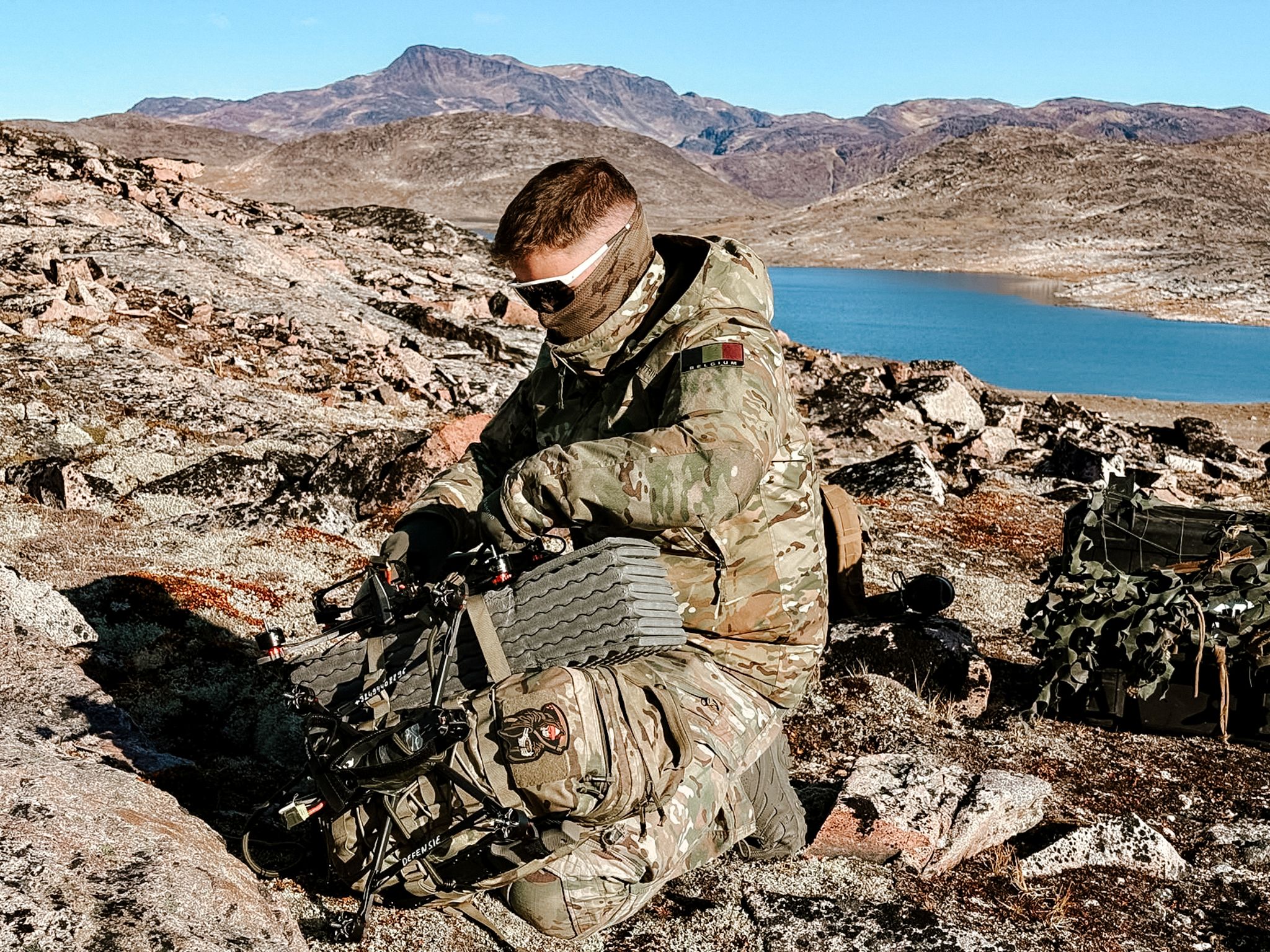
The Belgian Army has deliberately capitalised on these conditions by assembling a detachment of drone specialists from across the force. It includes experienced drone operators from the Motorized Brigade: a dedicated drone platoon from the ‘Battalion Bevrijding/5 Linie’, operators from the reconnaissance battalion ‘Jagers te Paard’ and counter-drone capabilities from the Artillery Battalion. A drone expert from the Special Operations Regiment also joined the detachment.
Over the course of nearly three weeks, these specialists were able to test and refine tactics in a unique Arctic training environment. They also exchanged experiences with military personnel from Finland, Denmark, and Canada, all of whom possess extensive expertise in Arctic and sub-Arctic operations. This enabled the Belgian participants to enhance their understanding of key challenges related to battery performance, connectivity, logistics, and the maintenance of unmanned systems in these types of environments. Opportunities to bring together such a large and diverse group of unmanned systems specialists are rare and highly valuable.
Arctic Shield therefore functions not only as a political engagement, but also as a valuable tactical learning opportunity. The interactions fostered through Arctic Shield also exemplify the intensified European defence cooperation that has become indispensable in light of the Russian threat. If European countries are to accelerate force generation and adapt to the rapidly changing character of warfare, multinational interoperability will be essential. Exercises of this nature contribute to both objectives.
As European armed forces rebuild after decades of underspending, some of the most substantial challenges are situated within the land forces. This is also where some of the most significant changes are taking place. Drones have not replaced troops, just as the tank did not make soldiers redundant, but fighting without drones is rapidly becoming unimaginable. Integrating land forces with unmanned and counter-unmanned aerial systems is therefore crucial. An exercise such as Arctic Shield, where a Belgian drone unit can advance its knowledge and skills under highly demanding conditions, represents both a tactical and a strategic gain.
In conclusion, while some may initially have laughed at the deployment of one or two soldiers to a massive island, that first reconnaissance has contributed to an exercise that brings allies together. At the political level, the diplomatic signalling was challenging but successful. At the military level, troops have been given a unique environment in which to train, experiment and learn from one another. Arctic Shield therefore illustrates Europe’s increasing capacity to adapt, both politically and militarily.
(Photo credit: “A Belgian drone-operator from the Battalion Bevrijding/5 Li, operating during Arctic Shield”. Credits: the Belgian Army)