
The EU Is Talking Strategy: Make it Worthwhile
In
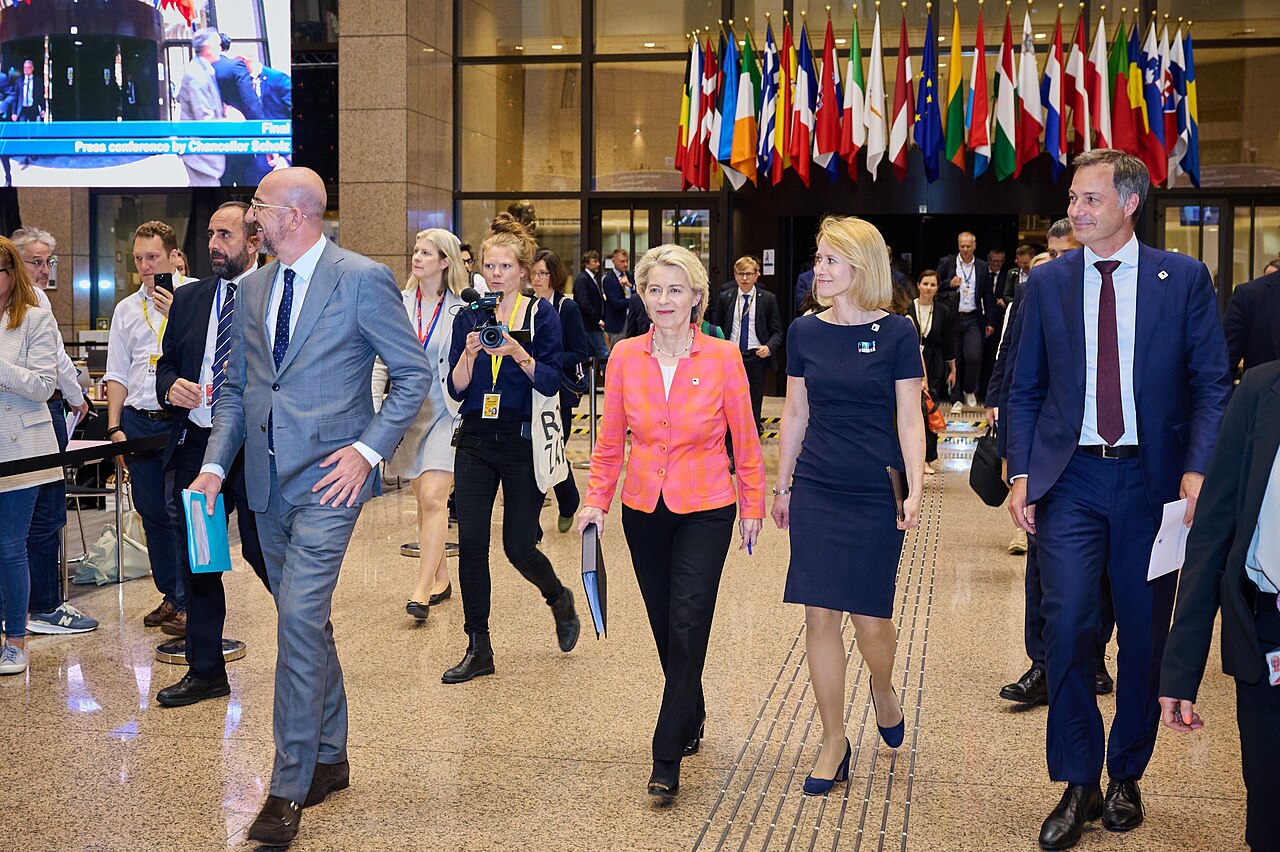
Commission President Ursula von der Leyen surprised observers and member states alike (and, apparently, High Representative Kaja Kallas) with her January announcement that the EU would draft a new European Security Strategy
*******
The EU Is Talking Strategy: Make it Worthwhile
Commission President Ursula von der Leyen surprised observers and member states alike (and, apparently, High Representative Kaja Kallas) with her January announcement that the EU would draft a new European Security Strategy (ESS). Now, two months later, the process is gaining steam. The EEAS circulated a scoping paper, and foreign ministers exchanged their views during the Council meeting on March 16. Kallas declared afterwards that the strategy will take a “broad view of security, linking defense, energy, supply chains, and other policy areas.” She highlighted member states’ involvement in shaping the strategy, which will be based on an updated joint threat assessment.
This is exactly the right moment for devising such a strategy. US President Donald Trump’s threats against Greenland, his illegal war against Iran, and his calls to support it, have united the Europeans in opposition. Coupled with Russia’s continued aggression in Ukraine and beyond and China’s challenge to the European (economic) model, the international environment is exposing Europe’s vulnerabilities in the starkest possible ways. The challenges are clearer than ever.
The ESS must confront a fundamental question: How can the EU and Europe more broadly achieve strategic independence while it remains constrained by the political and budgetary reality of member states’ unwillingness to further pool sovereignty and fiscal capacity?
In a world filled with strategic dilemmas and characterized by unpredictability, the necessity to formulate a document that aligns long-term ends, ways, and means might seem far-fetched. Strategy, as Moltke the Elder’s famous dictum that no plan survives contact with the enemy reminds us, is not about rigid plans but about preparing for the inevitable chaos of a world that today seems subject to the whims of an erratic US administration and hard-nosed geopolitics by adversaries while suffering from the increasingly disruptive impact of climate change. Strategy requires a habit of mind that enables adaptation through unforeseen events. Establishing this habit as a lasting coordination mechanism between the EU’s institutions and its member states is what makes playing a role in the world feasible at all. It is vital that this process endures after the strategy has been written, possibly in the form of a strengthened Council format that amounts to a European Security Council as proposed by Commissioner Kubulius. But the institutional setup remains secondary to the cultural and mental shift that has to take place to allow for real strategic behavior. Away from reactivity towards agility based upon a clear understanding of ends, ways, and means.
Setting a Realistic and Ambitious Goal
The EU is not a fully capable strategic actor. It does not provide for its own territorial defense and operates on a shoestring budget. The Commission last year presented an unambitious proposal for the next Multi-Annual Financial Framework. While the planned simplification and increased focus on defense and security represent a marked improvement, the foreseen modest increase in total expenditure barely accounts for inflation and the burden of repaying the Covid-era NextGen-EU loans. And even this minor boost to the EU’s budget is unlikely to survive negotiations with member state capitals. The Union’s institutional and budgetary limits are real yet not insurmountable barriers. They are the framework within which Europe must redefine its ambitions. The ESS must therefore confront a simple truth. If Europe waits for the perfect conditions, the moment to act will have passed. It must instead ask not what it can achieve in an ideal world but how it can defend its interests in the one it inhabits.
The EU cannot now hope to play the role of a great power as it is traditionally understood. However, it can constitute the core of a European pole in the international system within which its members and around which close partners (like the United Kingdom) can organize themselves. The EU must be a strategic enabler that empowers its member states to establish and safeguard their independence from outside actors, together. Formats of flexible cooperation among member states and partners in structured minilateral groupings should be explicitly embraced as a necessity. Coalitions of the willing and able are not imperfect substitutes; they are the architecture of action allowing member states and partners to move forward where the whole Union cannot. The ESS must normalize this approach, making it clear that to achieve strategic independence, not every state needs to be onboard for every initiative as long as sufficient mass and power are generated.
Strategy is Communication
Strategy, at its core, is an exercise in communication. To the outside world, it signals what role the EU aims to play in international affairs. First and foremost, it must signal resolve, drawing clear red lines on Europe’s core interests and establishing the consequences for crossing them. The coordinated responses by European leaders to President Trump’s threat to annex Greenland serve as an excellent example since it represented more than vague declarations of unity and solidarity. It consisted of a simple and direct narrative (hands-off Greenland) backed up by forceful action (deployment of military personnel and the threat to suspend the trade deal).
Internally, the ESS must create cohesion. It strives to align the Brussels bureaucracy, member states, and publics around a shared vision of threats and objectives. In times of populist contestation and external attempts to divide the Union, internal communication may be the most consequential part of the endeavor. A narrative centered on strategic independence as a necessity to keep the world safe for democracy can be envisioned. It must be communicated in language that is jargon-free, accessible, and resonant across the continent.
Conclusion
The ESS arrives at a moment when Europe can no longer afford timidity. The threats are clear: a revisionist Russia, an assertive China, and a predatory United States that treats allies as vassals. The Union’s response to an international environment characterized by overlapping crises must be equally clear. The strategy must establish a culture of coordination that transcends crisis-driven meetings and reconciles ambition with realism, acknowledging the Union’s institutional constraints while refusing to surrender to them. It has to prioritize and use resources where the EU can deliver tangible strategic benefits to its members. Finally, it needs to articulate Europe’s role in the world with precision and assertiveness.
This is not an academic exercise for analysts and the Brussels bubble. The upcoming ESS will either be a turning point or another missed opportunity for the Union and its members to achieve strategic independence. If it fails, Europe risks remaining, for a long time to come, a reactive and dependent spectator in a world shaped by increasingly hostile others. The process must endure beyond the document itself, embedding strategic thinking into the EU’s institutions and decision-making. Formats like a European Security Council or structured models of minilateral cooperation can bridge the gap between ambition and capability, but only if member states accept that strategy requires tough choices from each of them. The ESS is not the end of Europe’s strategic journey. It is the beginning of a habit of mind that turns constraints into advantages.
(Photo credit: Wikimedia Commons / © European Union, 2026)