
Sudanese Refugees in Chad: A Critical Humanitarian Response on the Brink of Collapse
In
Since the outbreak of civil war in Sudan three years ago, Chad has welcomed a rapidly growing influx of refugees and returnees, despite being among the poorest countries in the world.
*******
Sudanese Refugees in Chad: A Critical Humanitarian Response on the Brink of Collapse
Since the outbreak of civil war in Sudan three years ago, Chad has welcomed a rapidly growing influx of refugees and returnees, despite being among the poorest countries in the world. In response, a large-scale humanitarian operation led by United Nations agencies and non-governmental organizations (NGOs) has been mobilized, providing continuous life-saving assistance to more than 1.3 million refugees and returnees. The sustainability of this response, however, is increasingly uncertain, and its potential collapse would have severe consequences.
April 15, 2026, marked the third anniversary of the Sudanese conflict, a particularly violent civil war characterized by widespread and systematic violence on civilian populations. Since its onset, an estimated 14 million Sudanese have been forcibly displaced, a figure exceeding the total population of Belgium. The neighboring country of Chad has welcomed more than 1.3 million refugees and returnees, (equivalent to the entire population of Brussels walking the distance to Paris to find shelter). They have joined the 400.000 refugees that had remained in Chad since the previous conflict of 2003 in Sudan, with history eerily repeating itself after 20 years. Eastern Chad remains one of the poorest and most isolated regions of the world, hostile by the lack of basic services, resources, state structures or opportunities. Refugees and returnees are forced to live with the strict minimum that humanitarian aid can offer.
Desperate People Seeking Shelter in a Desperate Land
Refugees fleeing Darfur have endured unimaginable violence and many families arriving in Chad recount the horrors of their journey to safety: children forcibly recruited as soldiers, men executed because of their ethnicity, and women and girls subjected to widespread sexual violence. Most arrive with no belongings and in extremely fragile physical and psychological condition. Yet, the situation they encounter in Chad often falls far short of their expectations for refuge.
At the time of the first refugee influx in 2023, Chad ranked near the bottom of the Human Development Index, alongside countries such as Somalia, the Central African Republic, and South Sudan. This ranking reflects persistently poor outcomes across key development indicators, such as health, income, and education. Life expectancy, for example, remains at approximately 55 years, placing Chad among the lowest globally.
Within this already fragile national context, eastern Chad – particularly the provinces hosting the largest refugee population – exhibits even more severe levels of deprivation. Long-standing structural neglect, compounded by geographic isolation and harsh climatic conditions, has resulted in chronically low levels of investment and service provision. Even in the absence of crises, local populations face significant challenges in meeting basic needs.
A 2024 nutrition survey conducted jointly by the Chadian government and UNICEF highlighted the severity of these conditions. In Ouaddaï province, which hosts the largest number of refugees, the prevalence of Global Acute Malnutrition among children under five reached an average of 17.9%, exceeding emergency thresholds. By comparison, peak malnutrition rates among children in Gaza in 2024 were estimated at approximately 16.5%. Refugees arriving from Darfur frequently report that access to health and education services in Chad is significantly lower than in their areas of origin, illustrating the depth of structural underdevelopment in host communities.
A Massive and Complex Humanitarian Response
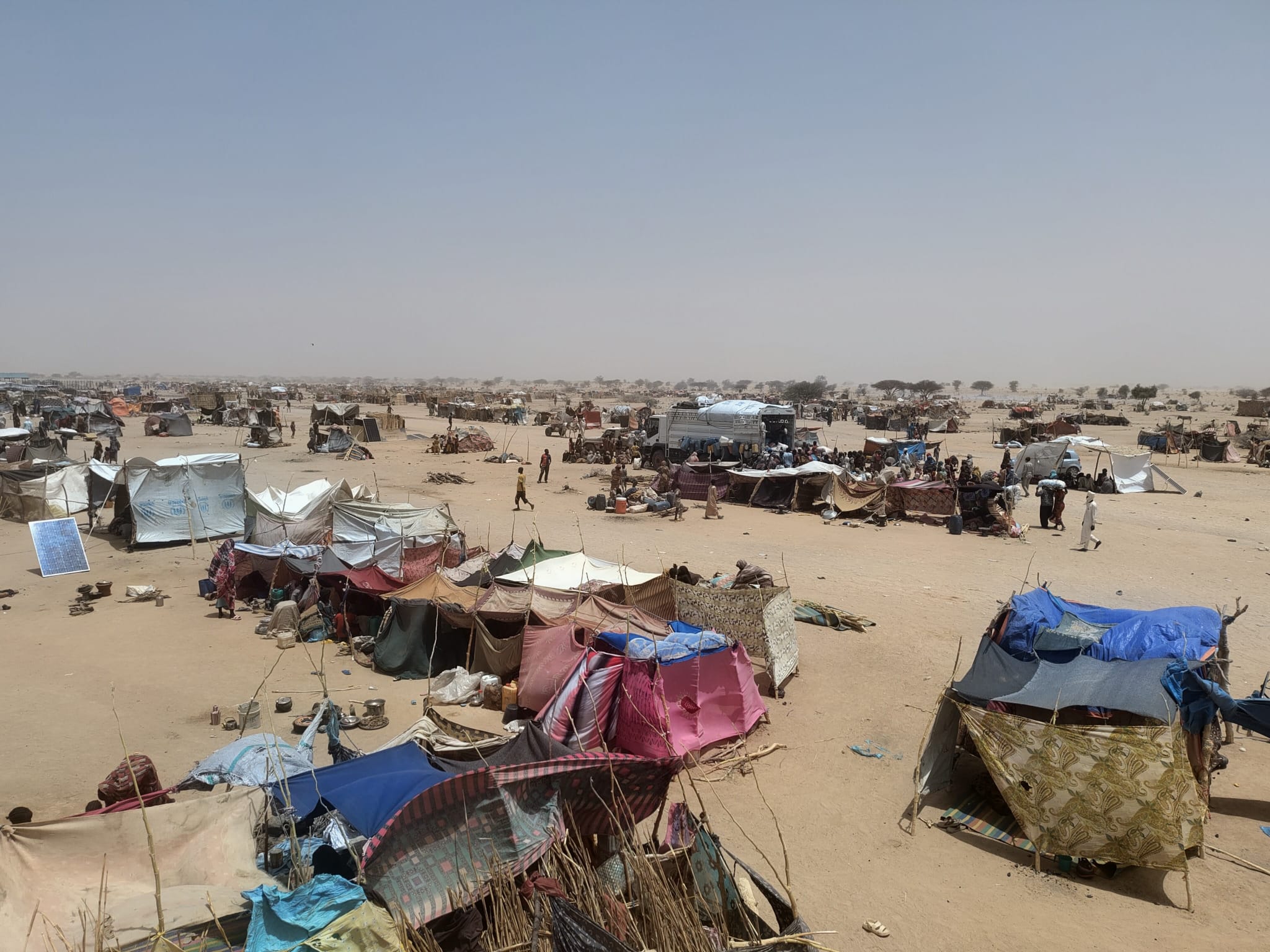
The arrival of Sudanese refugees and Chadian returnees in 2023 initially resulted in spontaneous settlements along the border, particularly in the vicinity of Adré, a key border crossing point. In response, humanitarian actors, in coordination with national authorities, initiated large-scale relocation efforts to establish formal refugee sites located further inland. The first such site, Aboutengué, was established approximately 30 kilometers from the border and rapidly expanded to accommodate nearly 50,000 individuals, effectively forming a densely populated, resource-constrained settlement. Over the subsequent three years, nine new refugee camps were established, each hosting between 40,000 and 50,000 persons, the majority of whom are women and children. However, despite the relatively progressive asylum policies of the Chadian government, the expansion of formal sites has been constrained by the lack of funding and the limited availability of suitable land. As a result, humanitarian actors have increasingly relied on expanding pre-existing camps originally established during the 2003 Darfur crisis, in some cases creating large-scale settlements of up to 100,000 inhabitants.
Notwithstanding these efforts, it is estimated that nearly one-third of the refugees that have arrived since 2023 have not yet been relocated to formal camps. Many have instead settled informally on private agricultural land in border areas, which has generated tensions with local authorities and host communities, highlighting the complex interplay between humanitarian needs and local resource constraints.
The establishment and maintenance of refugee camps in eastern Chad present significant logistical and operational challenges. These sites are typically located in semi-arid environments, far from existing infrastructure, necessitating the creation of all essential services from the ground up. Shelter construction, for instance, involves the use of tarpaulins and metal sheeting, supported by wooden frames that are transported from regions located over 1,000 kilometers away. Individual camps may contain up to 12,000 shelters, each housing a single household at an approximate cost of €500.
In the absence of functional public health systems, NGOs have established temporary clinics and nutrition centers within the camps. Although these facilities operate under highly constrained conditions and at a high cost, they often provide higher-quality care than what is available in surrounding rural areas, leading to increased demand from host populations.
Water access constitutes one of the most critical challenges. Eastern Chad experiences a highly seasonal climate, with rainfall concentrated in a brief two-month period and few permanent surface water sources. Accessing groundwater requires the drilling of deep boreholes, often exceeding 100 meters in depth, using specialized equipment. Achieving minimum humanitarian standards -typically 15 liters of water per person per day – therefore requires substantial infrastructure investments, including multiple diesel-powered wells, elevated storage systems, extensive piping networks, and distribution points.
Food assistance represents another cornerstone of the humanitarian response, accounting for a significant proportion of overall costs. Annual expenditures for food aid are estimated at up to €250 million. While Chad’s legal framework permits refugees to engage in economic activities (many refugees come from urban areas, are educated and have various competencies), practical opportunities remain limited, particularly in remote camp settings. In the absence of sustainable livelihood options, the World Food Programme continues to rely on large-scale food imports and complex distribution networks to reach approximately 900,000 beneficiaries each month across more than 30 sites. Cash-based interventions are hindered by the absence of banking infrastructure and telecommunications networks for mobile money. Despite these operational challenges, food assistance programs have contributed to maintaining relatively lower malnutrition rates within camps compared to surrounding host areas.
Many other issues affect the refugees: sexual violence remains a recurrent issue for women and girls in camps, mental health is neglected, there are conflicts with the host communities over access to firewood, water or land, and ensuring adequate education for refugee children is still a daunting challenge.
A Critical Juncture in 2026
The Sudanese crisis has received comparatively limited international attention relative to other major conflicts, such as Ukraine and Gaza. This has had direct implications for the level of humanitarian funding available: even prior to recent reductions, available resources were insufficient to fully meet the needs.
The sharp decline in United States humanitarian funding in 2025 has had a particularly significant impact. In Chad, the World Food Programme was compelled to reduce food rations by 50% in early 2026, resulting in daily caloric intake levels of approximately 850 kcal per person – well below established minimum requirements. Concurrently, the Office of the United Nations High Commissioner for Refugees (UNHCR) has faced constraints in expanding camp capacity and facilitating new arrivals. Essential services, particularly those related to reproductive health and gender-based violence, have also been substantially scaled back.
Although the European Union, as second biggest donor, has maintained relatively stable levels of humanitarian funding, it has not offset the reduction in U.S. contributions. In 2024, U.S. assistance to humanitarian operations in Chad amounted to approximately $350 million annually. By 2026, this figure had declined to $100 million, with funds to be channeled through the United Nations Office for the Coordination of Humanitarian Affairs (OCHA). This new US funding process has raised many questions and its durability and reliability remain uncertain.
The year 2026 thus represents a critical inflection point. In the absence of a political resolution to the conflict in Sudan and given the deteriorating conditions in host areas, displaced populations face increasingly constrained options. Prospects for local integration in Chad remain limited, while neighboring countries (Lybia, Central African Republic) offer similarly unfavorable conditions.
Emerging migration trends suggest that some refugees, particularly younger individuals, are undertaking the onward journey towards Europe. However, such movements entail significant risks and are not feasible for many, particularly vulnerable refugee households composed of women and children. Without a substantial and timely increase in international support, the humanitarian response in eastern Chad risks systemic failure, with potentially far-reaching and destabilizing consequences for both displaced populations and host communities.
A Way Forward with the Humanitarian-Development NEXUS
Addressing these challenges requires both immediate and long-term action. First, Sudan must be reprioritized as a major humanitarian crisis. Funding for Sudanese internally displaced persons and refugees should be urgently increased to prevent a collapse of the current response, and prevent Sudanese from displacing further. Second, greater emphasis must be placed on strengthening the humanitarian–development NEXUS to support the transition of refugees and host communities toward sustainable socio-economic resilience. Drawing on lessons from the previous Darfur crisis, it is evident that the displacement in Chad is likely to be protracted. This calls for a shift in approach: rather than relying primarily on humanitarian funding to build, staff, and maintain temporary infrastructure such as schools, health facilities, and water systems, development financing should be mobilized to deliver durable, long-term solutions, which remains possible due to the relative stability of Eastern Chad.
Similarly, the World Food Programme (WFP) requires adequate and predictable funding to transition from a broad, status-based assistance model to a more targeted, vulnerability-based system that prioritizes those most in need. This shift, which has already started in a timid way, would improve both efficiency and equity in aid delivery. The skills, education, and entrepreneurial capacity of Sudanese refugees represent a significant but underutilized asset. Development actors should invest in sectors such as agriculture, livestock, vocational training, and small business development, targeting both refugees and host communities. Such investments could help transform refugee settlements into economically active local hubs, reducing dependency on aid while fostering social cohesion.
Ultimately, enabling greater self-reliance among refugees would ease pressure on humanitarian systems, allowing them to refocus on acute and emerging needs. Achieving this vision will require sustained political commitment, coordinated financing, and a deliberate alignment between humanitarian and development strategies.
(Photo credit: Laurent De Ruyt)