Strengthening Local Security Governance in Fragile Contexts: Insights from ten years of experience in the DR Congo
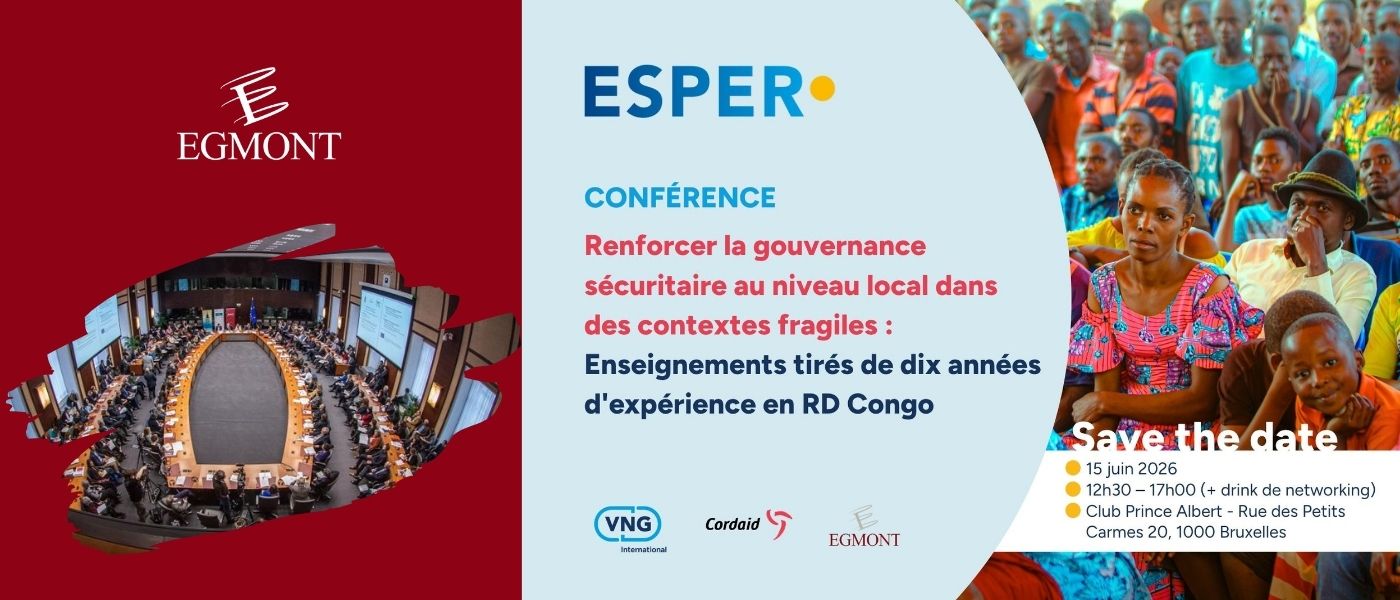
Date
15 June 2026
Time
12:30-18:00
Location
Club Prince Albert, Rue des Petits Carmes 20, 1000 Brussels
Type of Event
Conference
Organisation
VNG International, Cordaid and Egmont
Context
The Democratic Republic of the Congo faces a decisive political and security momentum. Persistent conflict, widespread violence against civilians, corruption and impunity have deepened mistrust between citizens and public institutions and weakened the delivery of basic services.
How is security administrated, by whom, and in whose interest ? Strengthening local security governance is a central element of state-building, decentralisation, and democratic accountability.
Improving local security and justice starts with strengthening the skills, capacity, and motivation of the authorities and the security and justice services. When authorities and services work better at all levels, local security committees can anchor real cooperation with citizens. Functional committees boost dialogue, accountability, and civilian oversight. This represents a shift from traditional top-down security models towards inclusive, people-centred, locally driven approaches.
Such an approach aligns with the EU’s renewed Great Lakes Strategy by addressing the governance and accountability deficits that underpin insecurity and resource-related tensions in the region. It contributes to conflict prevention, state legitimacy and regional stability by strengthening inclusive, citizen-centred security and justice governance. This helps ensure (natural) resources are managed transparently and sustainably, in line with the EU’s objective of promoting fair and conflict?sensitive partnerships in strategic value chains (e.g. Global Gateway).
Objectives
This conference aims for participants to better understand how strengthening local mechanisms can play a transformative role in reinforcing State institutions and improving service delivery.
Drawing on concrete evidence and field experience from the ESPER project, the exchanges will offer valuable insights into what works in practice—showcasing successes, unpacking challenges, and outlining practical steps for institutionalisation and scaling.
Most importantly, the conference will generate actionable, policy-relevant recommendations to inform and strengthen the EU’s stabilisation and peacebuilding efforts as well as strategic (economic) partnerships in the Democratic Republic of the Congo, the Great Lakes region, and beyond.
Please find here the programme.